
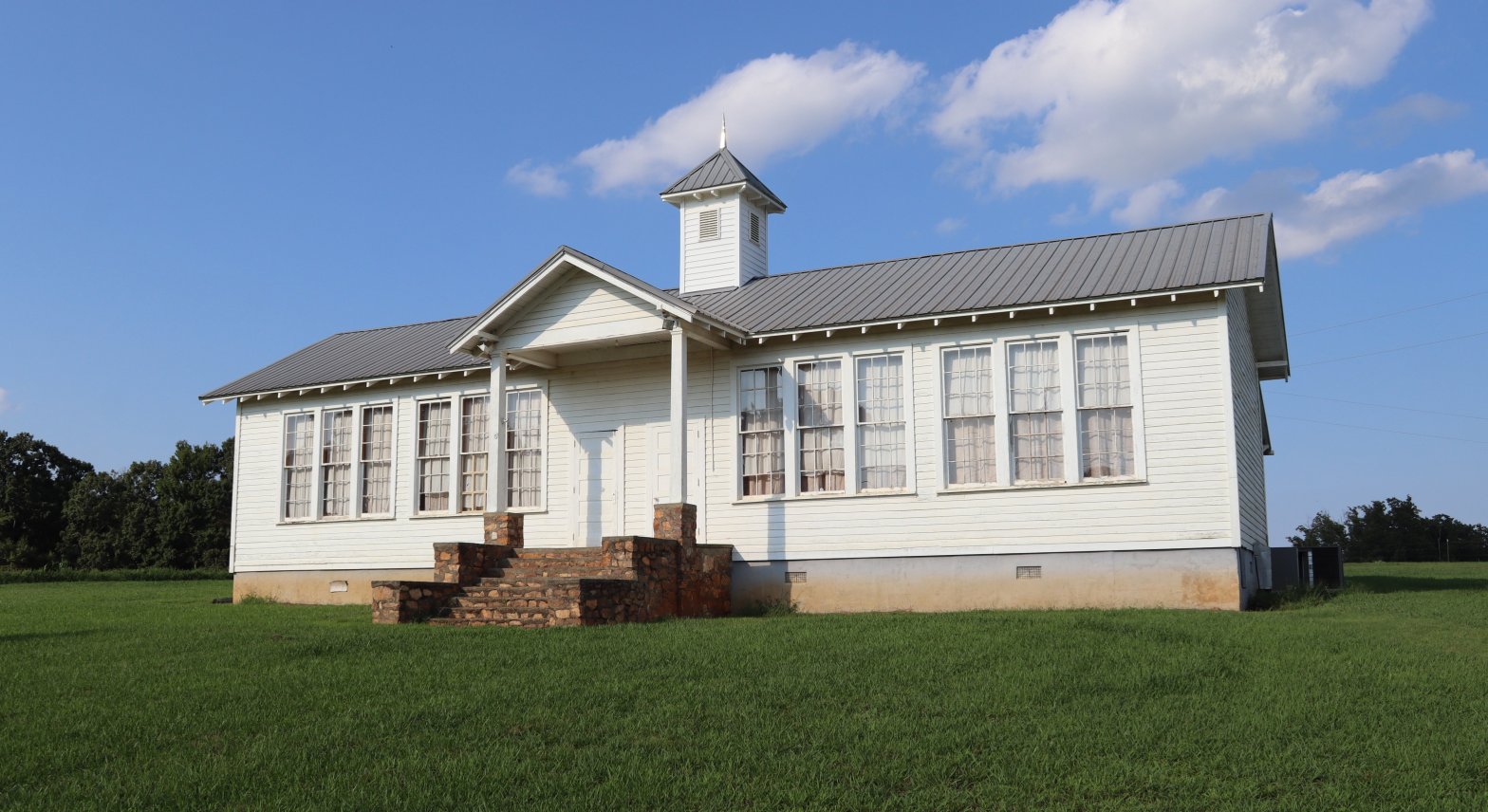
In the Sandy Springs community of northern Iredell county stands a reminder of the importance those who came before us placed on education.
Originally, the land this building is on was part of the Dalton’s plantation, “Daltonia”, with the main house sitting just shy of 3 miles down the road. It cannot be understated just how much property the Daltons once owned in this area.
At some point in the distant past, this particular piece of the old plantation was sold to the Joyner family. I haven’t been able to find out exactly when or to which specific Joyners, but it was before 1840.
In 1840, the first school building was constructed, not on this exact spot, but apparently close to the spring Sandy Springs is named for, probably along the creek which is about 600 yards behind the current school house. That one room log building was also used as a meeting place for Sandy Springs Baptist Church of Christ, the congregation which eventually became Sandy Springs Baptist Church.
How we got from that original building to the one that now stands is a little muddled.

In 1929, part of the Steelman school district was consolidated into Joyner. The Iredell county school board ruled that everyone on the eastern side of Kennedy Creek (Probably “Big Kennedy Creek”) would have to start attending Joyner. Parents at Steelman weren’t terribly happy about this according to the newspaper accounts from the time.
If you’d like to know more about the modest Steelman schoolhouse, there’s a whole book available.
But back to Joyner. The original building must have been replaced at some time before 1933 when there’s another building, described as a three room wooden frame structure, on the current site. One which was a casualty of arson.

Eventually, a 17 year old local boy was arrested for the crime. No details were ever given suggesting what proof there was that Cook had actually set the fire.

And apparently, whatever reason there was for arresting him didn’t quite hold up in court.

The county school board debated whether to actually even rebuild the school or just move the children from Joyner into Harmony up the road, but a group of parents swayed the board’s decision.

The large turnout at the first meeting and probably a couple others afterwards convinced the school board that Joyner was worth rebuilding and so construction began on the current building.

Years later in the local papers, a Mrs. Eva Templeton recalled how she helped as local trees were cut and finished in a family sawmill for the project. A contractor named Boone Turner from Harmony was hired for construction and assisted by the local men of the Joyner community.
The school reopened and life continued on. Oddly enough, this iteration of the school didn’t last all that long.
By 1944, whatever the school attendance had been before, it ended up being less than 20 students. Suggestion were made that the school be shuttered and the remaining pupils finally make their way to Harmony, as was suggested just 11 years earlier. The school was closed by 1946.
With the county out of the picture, the deed for the building and land reverted back to the Joyner family. They kept ownership of it until 1956 when they (Mr. & Mrs. Paul Joyner and Mr. & Mrs. W.B. Renegar) deeded the school building and land to the people of the community with the provision it be used as a community center or revert back to the Joyner heirs. Even before that though, it was still in use, as a Grange was started by some of the locals.

After becoming a community building, it saw pretty regular use for a couple decades. The Grange, 4H Club, Home Demonstration Club. Political speeches, vaccine clinics, family reunions, and even some of the first meetings of REA, the telephone collective that would bring telephone services to the outlying parts of the county. All of these things seem to peter off in the 70’s and 80’s, and the building fell into disrepair. Probably contributing to that was the death of Austin Renegar, who had been a self-appointed caretaker of the building and kept on top of it’s maintenance until he passed in 1979.


By 1992, it was not in great shape, and in April that year, a meeting of the local community was called to discuss the viability of saving the old building. The outcome was positive and it’s because of those efforts that the Joyner Community Center, once the Joyner School, is still with us today.


I’d like to include some other interesting items I found while researching the school. These are here below in chronological order.


Leave a Reply to Elaine RenegarCancel reply